
Best dog car seats for SUVs, sedans, Jeeps and Teslas (2026)
Key takeaways
- Two things change between vehicles and decide your purchase: how deep the rear footwell is, and what you have to anchor to. Your dog's size decides the product category. Your car decides which version of it fits.
- SUVs have deep footwells, so a hard-bottom extender turns the back row into a genuinely large flat platform. The same extender in a sedan gains you much less.
- Sedans are the opposite problem. Shallow footwell, higher window line relative to the seat, tighter bench. A small dog actually needs elevation here, where the same dog in an SUV can often already see out.
- Jeep Wranglers and Teslas each need one specific thing. A Wrangler needs material that survives mud and a narrower bench than you expect. A Model Y needs airflow and sightline under a glass roof that heats the cabin fast.
- Nothing here restrains a dog. The harness does, and what you clip it to changes by vehicle. Back seat means the belt or buckle. Cargo area means the tie-down D-rings, never a loose crate.
Most dog car seat advice treats the car as a constant and the dog as the variable. That gets it backwards about half the time. The dog decides which category of product you need, which our size guides cover. The vehicle decides which version of that product actually fits, and whether the setup you have in mind is even possible.
This guide is organized by vehicle. It covers SUVs, sedans and small cars, Jeep Wranglers and Tesla Model Ys, which between them account for most of the awkward cases. Pickup trucks are different enough to warrant their own page, and we cover those separately.
Vehicle geometry is the whole problem
Two measurements do most of the work.
Footwell depth determines whether a hard-bottom extender is worth buying. An extender fills the space between the back of the front seats and the rear bench, turning two levels into one flat platform. In a deep-footwell SUV that adds a large amount of usable surface. In a shallow sedan footwell it adds a strip, and you have paid extender money for hammock coverage.
Window line relative to seat height determines whether a small dog needs elevating. Sedans sit low with a comparatively high beltline, so a small dog on the bench sees door card and nothing else. SUVs sit high with more glass, and the same dog can often see out unaided. This is why boosters make more sense in small cars than in large ones, which is the opposite of most people's assumption.
Everything else follows from those two, plus what your particular car gives you to anchor to.
Which setup for your vehicle
| Vehicle | Best setup | Watch out for |
|---|---|---|
| Sedan or small car | Standard hammock, or a booster for a small dog | Shallow footwell makes extenders poor value. Rear buckles often sit deep in the seat bight. |
| Mid-size SUV | Hard-bottom extender on the back seat | Deep footwell is the advantage here. Measure bench width, which varies a lot between models. |
| Large SUV or 3rd row | Cargo area with a crate, or extender on the middle row | With the third row up the cargo area may be too shallow. Fold it flat or use the middle row. |
| Jeep Wrangler | Heavy-duty washable cover on the rear bench | Narrow bench, roll bar intrusion, and an interior designed to get wet. |
| Tesla Model Y | Mesh-window cover on the back seat | Glass roof heat load, and vegan leather that marks more easily than it looks. |
| Pickup truck | Crew cab rear bench only | Never the open bed. See our truck guide. |
Our 8 picks
Ranked from our catalog of 86 products, chosen to cover the distinct vehicle scenarios above rather than to rank one product type against itself. Prices and ratings are the values in our catalog at the time of writing and will drift.

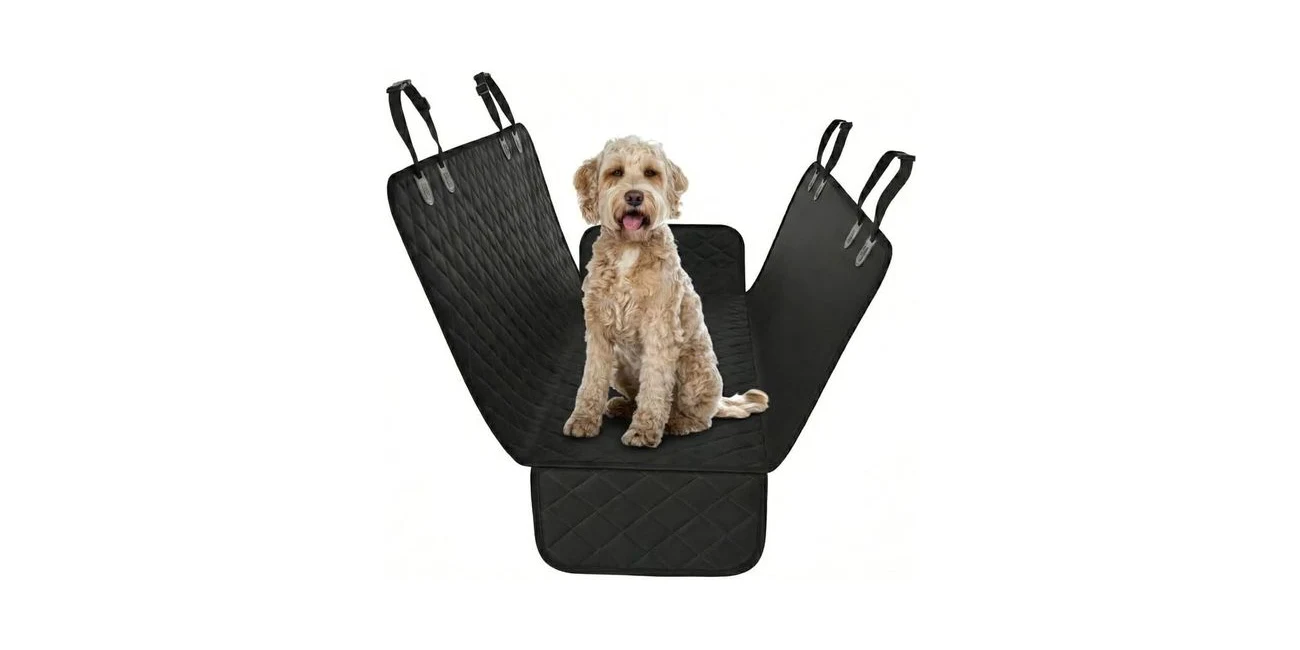
Active Pets Standard Dog Car Hammock
Fifty thousand reviews at 4.6 and the safest default if you are not sure what your car needs. The standard cut is the reason it is ranked above the XL version here: an XL hammock in a sedan bunches at the edges and never sits flat, while the standard size fits a normal bench properly and still works across a mid-size SUV. It slings from the front headrests to the rear ones, covering the seat back and filling the footwell gap, and the waterproof face handles a wet dog without wicking. It contains and protects. It does not restrain, so pair it with a harness on a belt anchor.
Check price on Amazon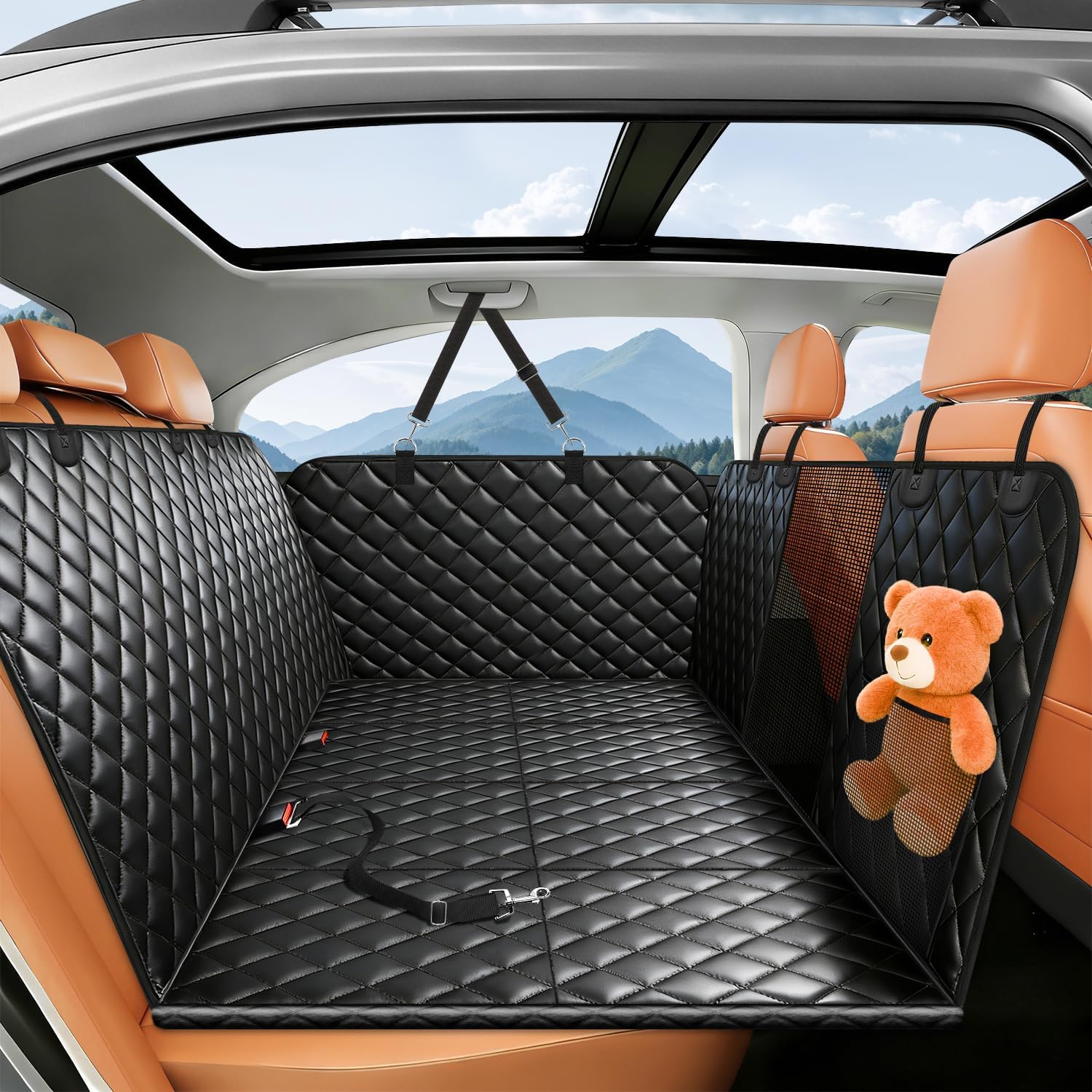
HOB4U Hard-Bottom Back Seat Extender
SUVs have deeper rear footwells than sedans, which is exactly the gap this fills. The rigid base spans seat to footwell so the back row becomes one flat platform, and in an SUV that yields a genuinely large usable surface, enough for a big dog to lie fully stretched. The same product in a sedan gives you far less, because the footwell is shallower to begin with. Waterproof and solidly built. If you drive an SUV and your dog lies down rather than sits, this is the upgrade over a hammock that you will actually notice.
Check price on Amazon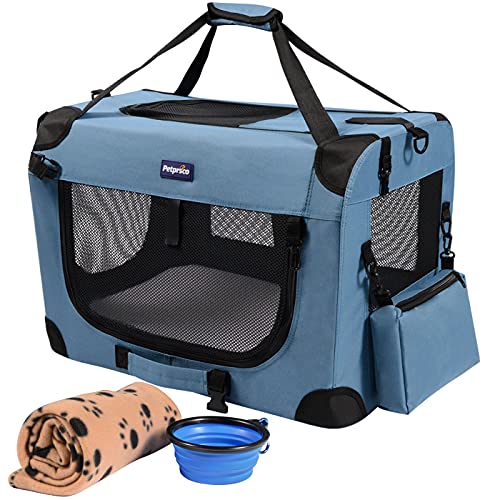
Petprsco Collapsible Travel Dog Crate
For an SUV or wagon with a real cargo area, behind the rear seats is often the better place for a big dog than the back bench, and a crate is what makes that work. It stops the dog moving around in a hard stop, keeps it out of the passenger cabin, and folds flat when you need the load space back. It also doubles as somewhere for the dog to sleep on an overnight trip, which is the reason people who genuinely travel with dogs end up here. Strap it to the cargo tie-down anchors: a crate sliding around loose in the back is worse than no crate. Containment, not crash protection.
Check price on Amazon
PETICON Seat Cover with Mesh Window
Our pick for a Model Y specifically, for two reasons that both come back to the glass roof. A panoramic roof puts far more solar load into the cabin than a metal one, so a solid-panel cover that traps warm air around the dog works against you, and the mesh panel lets heat move. The same panel keeps the dog in sight of the front seats, which matters in a car quiet enough that a dog notices when it cannot see you. Fully waterproof over the vegan leather, which scratches and marks more readily than people expect. Cheap enough that it is an easy first purchase for any car, not just a Tesla.
Check price on Amazon
600D Heavy-Duty Waterproof Seat Cover
A Wrangler is a mud vehicle, and mud is the whole design brief here. The 600D weave survives claws, grit and the repeated soaking a dog that has been in a river delivers, where a lightweight cover develops thin patches in a season. It wipes down rather than needing a wash cycle every week, which suits an interior already built around drain plugs and hose-out surfaces. Fit is the thing to check: a Wrangler rear bench is narrower than a normal car's and the roll bar structure intrudes, so measure before ordering and expect to adjust the strap routing.
Check price on Amazon
K and H Enclosed Dog Car Seat
A structured enclosure rather than a soft bucket, and the sensible answer for a small dog in a sedan or coupe where space is genuinely tight. It holds its shape instead of collapsing into the bench, so it does not eat the whole seat, and the enclosed sides settle a dog that would otherwise try to move around a small cabin. Good build from an established brand with more than two thousand reviews behind it. Sized for small dogs only. And as with everything else here, the enclosure contains the dog, the harness restrains it.
Check price on Amazon
Oiilores Washable Booster Seat
The cheap, practical option for a small dog in a sedan. A booster makes more sense in a low car than in a tall one: a sedan window line sits higher relative to the seat, so a small dog genuinely cannot see out without help, whereas the same dog in an SUV often can. Fully washable, which matters more in a small cabin where smells concentrate. The build is basic and the review count is still low, so treat it as a budget pick rather than a long-term one. For an occasional passenger in a second car it does the job.
Check price on Amazon
Mancro 600D Heavy-Duty Seat Cover
Eight and a half thousand reviews at 4.4 for under twenty-five dollars, and the honest answer when you want your seats protected and do not want to think about it further. Heavy 600D fabric, waterproof backing, standard bench sizing that fits most sedans and mid-size SUVs without drama. The 4.4 average is the lowest here and reflects fit complaints in unusually wide or sculpted benches rather than material failure. If you are buying a first cover to find out whether your dog even tolerates one, buy this before you buy anything expensive.
Check price on AmazonComparison at a glance
| Pick | Price | Rating | Best for | Spec |
|---|---|---|---|---|
| Active Pets Standard Hammock | $39.97 | 4.6 (50,842) | best all-round back seat, any vehicle | Standard bench, waterproof |
| HOB4U Hard-Bottom Extender | $59.99 | 4.6 (793) | best for SUV back seats | Hard bottom, back seat extender |
| Petprsco Collapsible Crate | $69.99 | 4.5 (2,587) | best SUV cargo-area setup | Collapsible, travel crate |
| PETICON Mesh Window Cover | $24.99 | 4.5 (5,991) | best for a Tesla Model Y | Mesh window, 100 percent waterproof |
| 600D Heavy-Duty Cover | $25.98 | 4.6 (3,872) | best for a Jeep Wrangler | 600D heavy duty, waterproof |
| K and H Enclosed Seat | $52.99 | 4.6 (2,167) | best structured seat for a small car | Enclosed, structured, small dogs |
| Oiilores Washable Booster | $25.99 | 4.6 (150) | best budget booster for a small car | Washable, small dogs |
| Mancro 600D Cover | $24.99 | 4.4 (8,536) | best budget cover for any vehicle | 600D heavy duty, waterproof |
By vehicle
SUVs: back seat or cargo area?
The genuine question for SUV owners, and the answer depends on the dog more than the car. Under about 70 lbs, the back seat with a hard-bottom extender is usually better: the dog is in the cabin with you, which most dogs prefer, and the deep footwell gives a large flat surface. Over 70 lbs, or for a dog that will not settle, the cargo area with a crate strapped to the tie-down anchors is the stronger setup. It keeps a heavy dog out of the passenger compartment in a hard stop and gives more room than any bench product.
Two SUV-specific traps. If you have a third row and it is upright, the remaining cargo space is often too shallow for a crate, so either fold it flat or use the middle row. And SUV load height is high enough that jumping down is a real impact for an older or heavy dog, so a ramp is worth more here than in a low car.
Sedans and small cars
The constraint is space, in every direction. The footwell is shallow, so an extender adds little. The bench is narrow, so a full hammock plus a passenger is usually not possible and a half-width cover is the practical compromise. And the window line is high relative to the seat, which is why a small dog in a sedan genuinely benefits from a booster where the same dog in an SUV might not.
The other sedan-specific annoyance is buckle geometry. Rear buckles on many sedans sit deep in the crease between cushion and backrest, which makes threading a cover's anchor straps fiddly and sometimes stops a seat sitting flat. Check yours before ordering, particularly on older cars.
Jeep Wrangler
A Wrangler is not a normal car interior and should not be treated as one. Three things matter.
The rear bench is narrower than most people expect, and the roll bar structure intrudes into the space where a cover's straps would naturally route. Measure, and expect to improvise the strap path. The interior is designed to get wet, with drain plugs in the floor and washable surfaces, which means a heavy wipe-clean cover suits it far better than anything that needs a wash cycle. And if you run with the top or doors off, the dog must be tethered short and securely, without exception. An unrestrained dog in an open Wrangler is a dog that can leave the vehicle, and the wind noise and buffeting will unsettle even a calm dog at speed.
Tesla Model Y
The Model Y needs a specific setup for reasons that are genuinely different from other cars rather than marketing distinctions.
The glass roof is the big one. A panoramic roof admits far more solar heat than a metal one, and the cabin warms faster than owners expect on a sunny day. That makes a solid-panel cover that boxes the dog in actively unhelpful, and a mesh panel worth choosing. Dog Mode keeps the climate running with the car parked and displays a message on the screen, which is a genuinely useful feature, but it depends on battery charge, so do not rely on it with a low state of charge and do not treat it as a license to leave a dog for long periods.
The interior surfaces are the second consideration. Vegan leather marks and scratches from claws more readily than it appears, and white interiors show everything. A waterproof cover is cheap insurance against an expensive repair. Third, the flat floor means no transmission tunnel, so the rear footwell is one continuous space rather than two wells either side of a hump, which is why covers often fit more cleanly here than in a comparable combustion car.
What to anchor to
None of these products restrain a dog. A correctly fitted harness does, and what it clips to changes with where the dog is sitting.
- Back seat. Clip to the seat belt itself, or to a short tether looped through the belt, or to the buckle. Not to a cover's fabric strap, which is not load-bearing.
- Cargo area. Clip to the cargo tie-down D-rings. These are structural and bolted to the floor pan. A crate should be strapped to them too rather than sitting loose.
- ISOFIX or LATCH anchors. Present in most rear benches and genuinely structural. A good option where a harness manufacturer supplies a compatible connector.
- Never to a headrest post alone, a grab handle, or a seat-back pocket. None are rated for anything like the loads involved.
Keep the tether short enough that the dog can sit, lie down and turn, but not step off the seat or build momentum before the strap stops it.
Frequently asked questions
Is the cargo area or the back seat better in an SUV?
Back seat for dogs under about 70 lbs, cargo area above that or for a dog that will not settle in the cabin. The cargo area keeps a heavy dog out of the passenger compartment in a collision and offers more room, but it only works if the dog is properly secured to the tie-down anchors rather than riding loose back there.
Do I need a different product for a sedan than for an SUV?
Often yes, though it is the same category. Sedans have shallow footwells, so hard-bottom extenders offer poor value and a standard hammock is usually the better buy. SUVs have deep footwells where an extender creates a genuinely large flat platform. Sizing differs too: an XL cover bunches badly in a sedan.
What is different about a Tesla Model Y?
Three things. The glass roof heats the cabin faster than a metal one, so ventilation and a mesh panel matter more. The vegan leather marks and scratches more easily than it looks, so a waterproof cover is worthwhile. And the flat floor means the rear footwell is one continuous space rather than split by a transmission tunnel, so covers often fit better than in a comparable combustion car.
Can I use Dog Mode instead of taking my dog with me?
Dog Mode keeps climate control running and shows a message on the screen, which is a real safety feature and better than nothing. It is not a substitute for judgment. It depends on the battery having charge, it can be interrupted, and it does not change the fact that a parked car is a poor place to leave a dog for an extended period. Use it for short stops, not as a plan.
What is special about setting up a Jeep Wrangler?
The rear bench is narrower than most cars and the roll bar structure gets in the way of normal strap routing, so measure and expect to adapt. The interior is built to be hosed out, which means a heavy wipe-clean cover suits it better than a machine-washable one. And with the top or doors off, a short secure tether is mandatory rather than advisable.
Will a hammock fit a three-row SUV?
On the middle row, yes, and that is usually the right place for it. It will not work across a third row, where there is rarely enough space between rows to sling it and the anchor points are not there. If your third row is permanently up, treat the vehicle as having a small cargo area and plan around the middle row.
Can I attach the harness to the headrest?
No. Headrest posts are designed to stop a head moving backwards in a rear impact, not to take the forward load of a dog in a frontal one. Use the seat belt, the buckle, an ISOFIX anchor, or a cargo tie-down. Grab handles and seat-back pockets are likewise not load-bearing.
My cover slides around. What am I doing wrong?
Usually one of three things: the cover is sized for a wider bench than yours and is bunching, the anchor straps are routed around something that moves rather than something fixed, or the non-slip underside has collected enough hair to stop gripping. Check the fit against your measured bench width first, since a too-large cover is the most common cause and no amount of strap tension fixes it.
For picks by dog size rather than vehicle, see our guides for small dogs, medium dogs and large dogs. For the full catalog see our seat covers and hammocks pages, and for correct fitting see how to install a dog car seat.